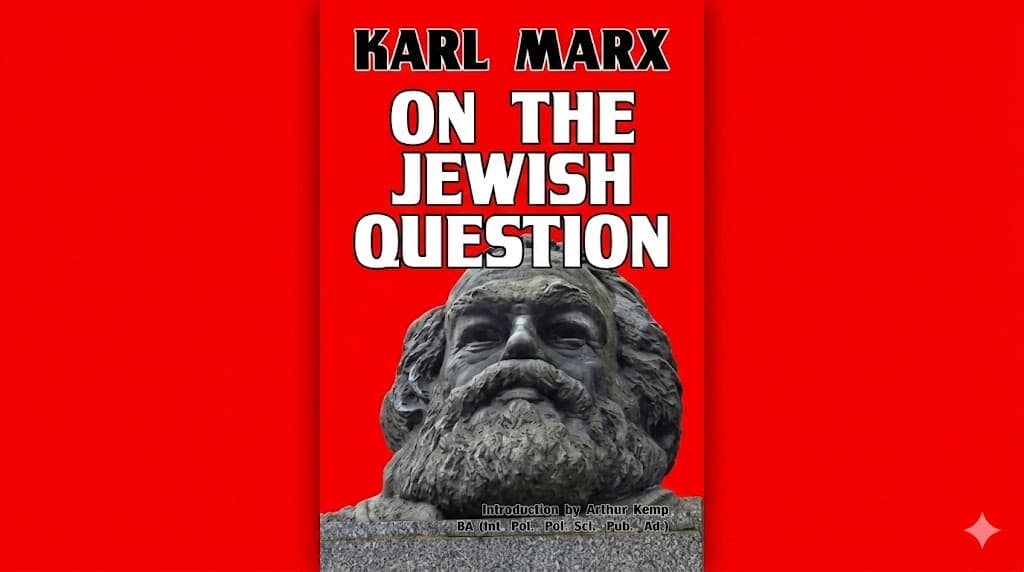
Karl Marx's On the Jewish Question (1844) A Critical Book Review from the Perspective of Socialist Jurisprudence
June 21, 2026
•
“The state can free itself from a restriction without man being really free from this restriction”
I. Introduction
Karl Marx's On the Jewish Question (1844) is one of the earliest and most influential works in the development of Socialist Jurisprudence and Marxist political philosophy. Written as a critique of Bruno Bauer's arguments on Jewish emancipation in Germany, the essay extends beyond religious freedom and addresses broader questions concerning the state, political emancipation, human emancipation, private property, and the relationship between civil society and political society.
The work occupies a significant position in Marx's intellectual development because it marks his transition from the idealism of G.W.F. Hegel to historical materialism. It marks a pivotal transition in his thinking away from abstract philosophy toward the materialist and economic theories that would later define Marxism. Marx argues that political emancipation, although an important achievement of modern constitutional states, does not amount to complete human emancipation. True freedom requires the abolition of social and economic structures that create alienation and inequality.
From the perspective of Socialist Jurisprudence, On the Jewish Question is particularly important because it presents Marx's early critique of liberal rights, the capitalist state, and private property. The book remains relevant in contemporary debates concerning secularism, minority rights, citizenship, and the relationship between law and social justice.
II. Historical Background
On the Jewish Question was written in 1843 and published in 1844 in the Deutsch–Französische Jahrbücher. Marx wrote the essay in response to Bruno Bauer[1] works The Jewish Question and The Capacity of Present-day Jews and Christians to Become Free.
Bauer argued that Jews in Prussia (Germany) should not be granted political emancipation (equal civil and political rights) unless they completely abandoned their religion. He believed that a truly secular state couldn't exist if its citizens still held religious identities, and that a Christian state could not emancipated non-Christians. He argued that Jews could not achieve emancipation while maintaining their religious identity and that both Jews and Christians should abandon religion altogether. Marx rejected Bauer's theological approach and transformed the debate into a political and social question. Marx used this debate to launch a much broader critique of liberal politics, arguing that Bauer completely misunderstood the nature of freedom. According to Marx, the real issue was not religion itself but the socio-economic conditions that produce religious and political inequalities.The essay was written during a period of growing liberal constitutionalism in Europe. Questions concerning citizenship, religious freedom, and equality before law were central political issues. Marx's intervention was therefore both philosophical and political.
III. Structure and Argument of the Essay
A. Part One: The Critique of Bauer
The book is divided into two essays. In the first essay, Marx criticizes Bruno Bauer's view that Jews must give up Judaism before they can become politically free. Bauer believed that religious emancipation should come before political emancipation. Marx disagrees with this argument.
Marx uses the United States as an example. He points out that America had achieved political freedom and separation of church and state, yet religion continued to exist and flourish. Thus, political emancipation does not require the abolition of religion. A state can separate itself from religion while people continue to practice religion in private.
This leads Marx to make an important distinction between political emancipation and human emancipation. Political emancipation means granting equal legal and political rights to citizens. Human emancipation means removing social and economic inequalities so that people can fully develop their human potential. Marx argues that political emancipation alone cannot achieve complete freedom because people may remain economically and socially unequal even after receiving equal political rights.
Marx also criticizes the liberal concept of the "rights of man" found in the French Declaration of Rights.[2] Rights such as liberty, equality, property and security, according to Marx, mainly protect the interests of isolated individuals rather than promoting social solidarity. These rights safeguard private interests and strengthen bourgeois society instead of creating genuine human freedom.
Thus, Marx concludes that political emancipation is an important achievement, but it is not the final goal. True human emancipation requires transforming society itself and overcoming social and economic inequalities.
B. Part Two: The "Practical Jewish Question"
The second essay is shorter but more controversial. Here, Marx shifts his discussion from religion to economics and society. He argues that the real basis of Judaism in modern society is not religion but commerce and money. Marx famously asks:
"What is the worldly cult of the Jew? Bargaining. What is his worldly god? Money."⁴
By this, Marx does not simply criticize Judaism as a religion. Rather, he argues that the values associated with money, trade, and self-interest have become dominant throughout capitalist society. In his view, these values are not limited to Jews, they characterize modern bourgeois society as a whole.
Thus, Marx changes the question from "How can Jews be emancipated?" to "How can society free itself from the domination of money and selfish interests?" He argues that human emancipation will only be possible when society overcomes capitalism and the alienating power of money.
Marx further criticizes liberal rights, such as liberty, equality, property, and security, because they mainly protect egoistic individuals rather than encouraging collective welfare and social cooperation. According to him, real freedom can exist only when social power is no longer separated from individuals in the form of the state and when economic exploitation and alienation are abolished. Thus, Marx concludes that human emancipation requires not only political rights but also a transformation of society and its economic structure.
IV. Major Themes and Contributions to Socialist Jurisprudence
A. Political Emancipation vs. Human Emancipation: The Illusion of the Liberal State
The main idea of On the Jewish Question is the distinction between political emancipation and human emancipation. Political emancipation means giving people equal rights before the law and allowing them to participate in politics. Human emancipation means removing social and economic inequalities so that people can truly become free.
Marx argues that giving people equal political rights is an important achievement, but it does not guarantee real freedom. A person may be equal before the law and still suffer from poverty, exploitation, and social inequality.
According to Marx, the modern liberal state divides human beings into two separate identities:
- The Citizen – In political life, a person is treated as an equal citizen who possesses rights and participates in public affairs.
- The Bourgeois Individual – In everyday economic life, the same person becomes an isolated individual who competes with others for wealth, property, and personal interests.
Thus, equality exists in politics, but inequality continues in society.
Marx also criticizes the liberal idea of the "Rights of Man."[3] Rights such as liberty, equality, property, and security appear universal, but according to Marx they mainly protect private interests. Instead of bringing people together, they allow individuals to pursue their own interests separately from society. In this sense, these rights protect the existing capitalist system rather than creating genuine human freedom. Thus Marx argues that the state may be secular and democratic, yet its citizens can still be economically oppressed and socially divided. Political emancipation creates an appearance of freedom, but it does not remove the root causes of inequality.
This distinction between political emancipation and human emancipation became one of the foundations of Socialist Jurisprudence. Socialist thinkers argue that formal legal equality is not enough if people continue to experience poverty, exploitation, and unequal access to resources. Marx's argument marks an important turning point in his intellectual development. He moves beyond criticizing particular laws or governments and begins to criticize the entire structure of liberal capitalist society. According to Marx, The state, does not eliminate social inequalities, it merely recognizes everyone as equal while allowing those inequalities to continue in civil society.
So Human emancipation requires more than political rights. It requires a transformation of society itself. True freedom will exist only when economic exploitation, excessive dependence on money, and social divisions are removed, allowing individuals to develop their abilities collectively and live as genuinely free human beings.
B. Critique of Liberal Rights
Marx argues that liberal rights protect the isolated individual rather than promoting collective welfare. Rights such as liberty and property are expressions of egoistic individualism.
He writes that the so-called rights of man are:
"Nothing but the rights of a member of civil society, namely egoistic man separated from other men and from the community."
This critique influenced later socialist jurists who argued that law under capitalism primarily protects private property and class interests.
C. Religion and the State
Marx departs from Bauer by arguing that religion is not the root cause of oppression. Rather, religion reflects deeper social and economic conditions. Marx argues that political emancipation does not abolish religion because religion is rooted in civil society and social conditions.
his idea first appears in On the Jewish Question and is developed more fully in Contribution to the Critique of Hegel's Philosophy of Right: Introduction, where Marx famously describes religion as "the sigh of the oppressed creature" and "the opium of the people." So Religion is not the cause of human suffering but a response to alienation and social injustice.
"Religion is the sigh of the oppressed creature, the heart of a heartless world, and the soul of soulless conditions. It is the opium of the people." [4]
D. Alienation and Civil Society
"In the state, where man is regarded as a species-being, he is the imaginary member of an illusory sovereignty... in civil society, he is active as a private individual, treats other men as means, reduces himself to a means, and becomes the plaything of alien powers."
Marx means that in a modern liberal state, people have two different identities. In the political sphere, they are treated as equal citizens who possess rights and participate in the state, but this equality is mostly imaginary or formal. In everyday life, that is, in civil society, people act as private individuals pursuing their own interests, competing with others, and often using others as means to achieve their goals. As a result, people become controlled by external forces such as money, private property, and market competition. Thus, Marx argues that political equality alone does not create real freedom because social and economic inequalities continue to dominate people's actual lives. This division creates alienation. The state proclaims equality, but civil society remains characterized by inequality and competition. The argument later became central to Marx's theories of alienation and class struggle.
V. Critical Evaluation
The book has received both praise and criticism.
First, Marx's distinction between political and human emancipation has been widely praised. Political theorist Shlomo Avineri argues that the essay marks Marx's transition from liberal constitutionalism to a social theory centered on human liberation.[5]
Second, scholars have appreciated Marx's critique of formal equality. Robert C. Tucker observes that Marx exposes the limitations of liberal rights by showing how economic inequalities persist despite legal equality.
But, the work has also been controversial. Several scholars argue that Marx's characterization of Judaism as associated with money and commerce reproduces negative stereotypes about Jews.
Isaiah Berlin acknowledges Marx's profound critique of capitalism but notes that parts of On the Jewish Question contain formulations that are problematic from a modern perspective.
Similarly, Jonathan Sacks argues that Marx's language concerning Judaism reflects nineteenth-century prejudices and should be read critically and within its historical context.
Nevertheless, many scholars defend Marx by arguing that his critique is directed primarily at capitalism and bourgeois society rather than Judaism as a religion or ethnic identity.
Criticism of Karl Marx’s On the Jewish Question generally focuses on its two most significant vulnerabilities: conceptual reductionism and the problematic nature of its language.
1. The Trap of Economic Reductionism
Marx’s core flaw in this text is his insistence on reducing complex cultural, religious, and identity-based struggles entirely to economics. By arguing that religious differences and social alienation will simply evaporate once capitalism is abolished and human emancipation is achieved, Marx fundamentally misunderstands the enduring, independent power of cultural and religious identity. History has repeatedly shown that eliminating private property does not automatically erase deep-seated ethnic, religious, or social biases.
2. Legal Naivety (Dismissing "Law in Books")
In his haste to expose the limitations of the liberal state, Marx dangerously minimizes the value of formal political rights. While it is true that legal equality does not automatically solve economic inequality, dismissing civil liberties and constitutional protections as mere bourgeois illusions is a luxury of abstract philosophy. For marginalized minorities, "political emancipation" the formal right to vote, hold office and be protected under the law is not a trivial (little value) distraction, it is a vital shield against state-sponsored persecution.
3. Problematic Language and Its Consequences
Even if one accepts the argument that Marx used "Judaism" as a metaphor for commercial capitalism and money-centered society, his language in Part II remains highly problematic. By using negative stereotypes about Jews that were common in nineteenth-century Europe, Marx weakened his own argument. Instead of supporting the liberation of all people, his language risked reinforcing prejudices that later contributed to discrimination and persecution of Jews.
In short, Marx correctly exposes the hypocrisy of liberal democracies that promise equality before the law while allowing deep economic and social inequalities to continue. But, his solution overlooks the importance of cultural and religious identities, underestimates the value of legal rights in protecting individuals and is weakened by the prejudiced language used in some parts of the essay.
VI. Contemporary Relevance
Despite being written in 1844, On the Jewish Question remains relevant today. Marx's distinction between political emancipation and human emancipation continues to influence debates on constitutional law, social justice, and human rights. His argument that formal equality before the law does not necessarily remove social and economic inequalities is still discussed by legal scholars and political theorists.
Marx's criticism of liberal rights has also shaped discussions on socio-economic rights, welfare states, and distributive justice. His analysis of alienation helps us understand problems associated with modern capitalism, consumerism, and growing social inequality. Similarly, contemporary debates on secularism, religious freedom, and minority rights raise questions similar to those discussed by Marx and Bauer nearly two centuries ago.
The essay's central argument that legal equality alone cannot transform unequal social conditions has been applied to many struggles for justice, including racial equality, women's rights, and post-colonial constitutional reforms. It raises an important question that remains relevant today: Can legal rights alone create genuine equality or is broader social and economic change necessary?
This question is particularly significant for countries like Nepal. The Constitution of Nepal, 2015 guarantees equality and prohibits discrimination based on caste, gender, ethnicity, religion, and other grounds. But, social and economic inequalities continue to exist in practice. Marx's argument reminds us that constitutional rights are essential, but they must be accompanied by social and economic reforms if genuine equality and human freedom are to be achieved.
So, despite its controversial aspects, On the Jewish Question remains an important work in Socialist Jurisprudence because it challenges us to think beyond formal legal equality and consider the social conditions necessary for real human emancipation.
VII. Conclusion
On the Jewish Question is not simply a discussion about Jewish emancipation. It is one of Karl Marx's earliest and most important critiques of liberal constitutionalism and capitalist society. The essay introduces ideas that later became central to Socialist Jurisprudence, such as the distinction between political and human emancipation, criticism of liberal rights, the relationship between the state and civil society, and the problem of alienation.
The work is both insightful and controversial. On the one hand, Marx presents a powerful argument that formal equality before the law does not necessarily lead to real social and economic equality. His critique of liberal rights and his emphasis on substantive freedom continue to influence political theory, constitutional law, and critical legal studies today. On the other hand, some parts of the second essay have been criticized for using negative stereotypes about Jews and for associating Judaism with money and commerce. Such language weakens Marx's argument and remains problematic from a modern perspective.
Thus, On the Jewish Question should be read critically. It is neither simply an antisemitic text nor an unquestionable manifesto of liberation. Rather, it is the work of a young Marx who was developing ideas that would later shape Socialist thought and jurisprudence. Its strengths and weaknesses together make it an important text for understanding the relationship between law, society, equality and human freedom. Despite its limitations, On the Jewish Question remains an indispensable work for understanding Marx's jurisprudence and the foundations of Socialist legal thought.
[1] A Hegelian philosopher (and Marx’s former friend).
[2] Declaration of the Rights of Man and of the Citizen of 1793
[3] Rights of Man is a book by Thomas Paine first published in 1791, including 31 articles, positing that popular political revolution is permissible when a government does not safeguard the natural rights of its people. Using these points as a base, it defends the French Revolution against Edmund Burke's attack in Reflections on the Revolution in France (1790). It was published in Britain in two parts in March 1791 and February 1792.
[4] Marx wrote this passage in 1843 as part of the introduction to Critique of Hegel's Philosophy of Right, a book that criticized philosopher Georg Wilhelm Friedrich Hegel's 1820 book, Elements of the Philosophy of Right.
[5] Shlomo Avineri, The Social and Political Thought of Karl Marx (1968).