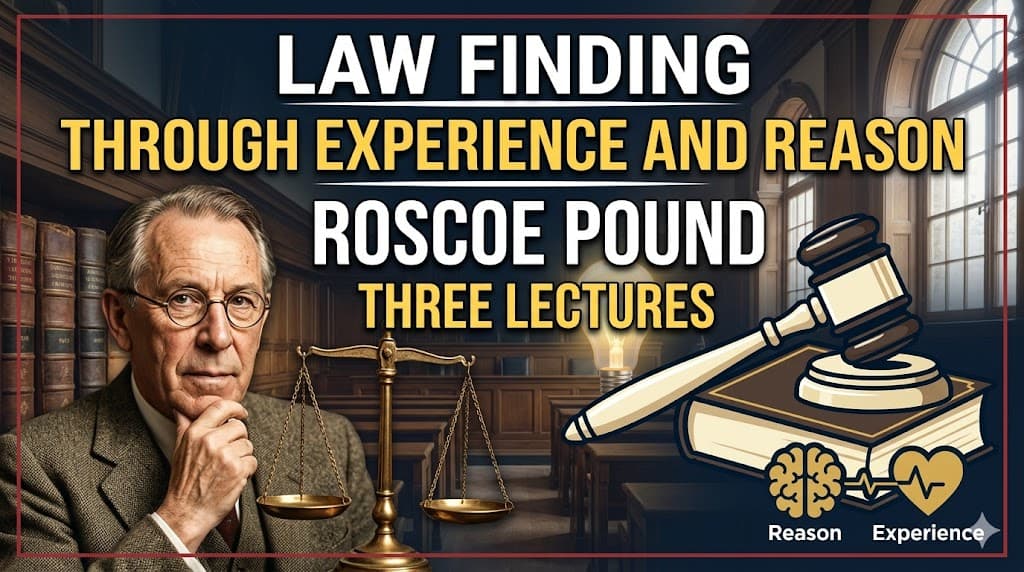
LAW FINDING THROUGH EXPERIENCE AND REASON: ROSCOE POUND'S THREE LECTURES
June 21, 2026
•
ABSTRACT
Roscoe Pound’s Law Finding Through Experience and Reason explains sociological jurisprudence through three lectures on how law is discovered rather than simply made. Its main idea is that “law is experience developed by reason and corrected by further experience,” showing that law grows through the interaction of real social life and judicial thinking. Pound distinguishes between “law,” which refers to general principles based on experience, and “laws,” which are formal rules made by the state. He discusses stare decisis (precedent) and explains that it is important for stability but should not be followed blindly if it leads to injustice or outdated results. He also explains the difference between reason and reasoning, warning that strict logical thinking or weak analogies can lead to unfair decisions. By engaging with different schools of legal thought, Pound promotes a practical and flexible approach to law that considers social needs and changing conditions. Overall, he presents law as a continuous process shaped by experience, reason, and judicial practice.
Keywords: Roscoe Pound, sociological jurisprudence, law finding, experience and reason, stare decisis, judicial reasoning, legal realism, legal philosophy, analogy in law, judicial discretion
I. INTRODUCTION
Roscoe Pound was born in Lincoln, Nebraska, in 1870. His academic formation was unusual: trained first as a botanist (he obtained a doctorate in botany from the University of Nebraska in 1897), he subsequently pursued legal study and was admitted to the Nebraska bar. He served as Dean of Harvard Law School from 1916 to 1936, during which period he transformed it into a preeminent centre of American legal education. By the time he delivered the Georgia lectures in 1960, he had published some of the most important works in American jurisprudence, including The Spirit of the Common Law (1921), An Introduction to the Philosophy of Law (1922), Social Control Through Law (1942), Justice According to Law (1951), The Ideal Element in Law (1958), and his monumental five-volume Jurisprudence (1959).[1]
Roscoe Pound (1870–1964), Dean Emeritus of Harvard Law School, delivered the three lectures published as Law Finding Through Experience and Reason to inaugurate the centennial celebration of the University of Georgia School of Law. As Dean J. Alton Hosch records in the Foreword, Pound gave these lectures in his ninetieth year, having devoted, in the Dean's words, seventy years to the science of law as lawyer, judge, author, and law teacher. The lectures are compact sixty-five printed pages but jurisprudentially dense. Together they constitute Pound's mature and final statement on the fundamental question he had addressed throughout his career: how is law found, as distinguished from how laws are made?
The answer Pound gives in the Preface defines the thesis of the whole work. He writes: 'In America we have inherited and developed the English faith in doing all things according to law. Moreover, as part of that inheritance, we have thought of law, not as something made, expressing will, but as something found, expressing reason. [2] But Pound immediately qualifies this: common-law thinking has not operated in the abstract. Judges have had a task of applying reason to specific items of experience and thus reaching starting points for reasoning as experience has raised new problems.'[3] From this tension between experience and reason, and the further tension between reasoning and reason itself, the three lectures unfold.
This paper analyses each lecture in sequence, drawing exclusively on the primary text. The purpose is to demonstrate that Pound's three lectures form a coherent argument: Lecture One establishes the distinction between Law (as body of principles found by reason applied to experience) and laws (as rules made by political authority); Lecture Two examines how the doctrine of stare decisis mediates the conflict between legal stability and legal growth, and surveys the schools of twentieth-century jurisprudence that bear on law finding; Lecture Three diagnoses the failure of courts to distinguish reason from mere reasoning, illustrating through ten concrete cases how inept analogies have distorted modern law.
II. LECTURE ONE: LAW MAKING AND LAW FINDING
A. Three Meanings of 'Law' and the Distinction between Law and Laws
The first lecture distinguishes between “law making” and “law finding.” Pound argues that law is not merely created by legislation. Judges also participate in the development of law through interpretation and application of legal principles. He distinguishes between “law” and “laws.” According to Pound, “law” refers to ideals, principles and standards of justice, while “laws” refer to enacted rules imposed by political authority. Pound opens the first lecture by drawing a fundamental distinction that the English language, unlike Latin, French, German, or Italian, largely obscures. He identifies three senses in which the English word 'law' is commonly used.
· First, it refers to a regime of ordering society.
· Second, it refers to a body of precepts by which that regime is carried on.
· Third, it refers to an aggregate of precepts constraining conduct.
Pound begins by explaining the difference between law and laws. According to him, law means a system of ideals, principles, and rules that guides human behaviour and helps maintain justice in society. Its main purpose is to achieve fair and equal justice for everyone. In contrast, laws are the formal rules created by the state mainly to maintain order and peace. Pound argues that true law develops from human experience. People observe social life, use reason to understand problems, and then improve legal principles through further experience. Therefore, law is not simply invented by governments; it is gradually discovered and refined through society’s practical experiences. In his words, “Law is found; laws are made.”
This distinction is central to his jurisprudence. He argues that legislation alone cannot resolve every legal dispute because human society constantly changes. Judges therefore play a creative role in adapting legal principles to new situations.
Pound criticizes analytical jurisprudence, particularly the theory associated with John Austin, which treated law as commands issued by a sovereign. Pound argues that such theories overemphasize political authority and ignore the moral and experiential foundations of law. According to him, legal development cannot be understood solely through legislation because common law historically evolved through judicial decisions.
B. Four Stages of Legal Development
One of the most systematic sections of Lecture One is Pound's account of four stages in the development of law.
· The Stage of Strict Law
· The Stage of Equity and Natural Law
· The Stage of Maturity of Law
· The Stage of Socialization of Law
The first stage is the stage of the strict law. The stage of strict law focused rigid rules, formalism and certainty. Its characteristics are formalism, rigidity and immutability, extreme insistence that everyone look out for himself, refusal to take account of moral aspects of situations, and 'arbitrary restriction of legal personality' only legal persons narrowly defined have recognised rights and duties.[4] The strict law advanced from primitive peacekeeping to the idea of legal remedies and the general security, developing certainty and uniformity through rule and form.
The second stage is equity and natural law. Sir Henry Maine gave it this name, and Pound accepts it as apt. In Roman law it covers the period of the great jurists from Augustus to the early third century A.D.; in common law it is the age of the rise of Chancery, the seventeenth and eighteenth centuries. Equity and natural law later introduced flexibility, morality and principles of fairness. The law begins to look at the "spirit" rather than just the "letter." Concepts like "good faith" and "conscience" become important.
The third stage is the maturity of law, which the nineteenth century reached in both the Roman and common law worlds. Its focuses are equality and security. Its characteristic institutions are property and contract. This stage is a reaction to the potential unpredictability of the "Equity" phase. The focus shifts to property and contract. The law aims to be systematic, scientific, and predictable so that people (and businesses) know exactly where they stand. It attempts to strike a balance between individual rights and commercial stability. The maturity of law focused on individual rights, property and contractual freedom.
The fourth stage emergent in Pound's own time the socialization stage focused on social interests and limitations on unrestricted individualism. Pound’s final stage (and the one he lived through) views law as an instrument of social engineering. The focus shifts from the individual to the community. The law starts to limit individual rights if they interfere with the "social interest" (e.g., labor laws, environmental protections, and public health).
C. Law as Experience and Reason
Pound argues that law develops through “experience developed by reason and corrected by further experience.” Pound’s most important contribution is his synthesis of experience and reason. He rejects two extreme positions:
- Pure formalism based solely on logic and fixed rules.
- Pure judicial subjectivity based entirely on discretion or personal morality.
Instead, Pound argues that law develops through interaction between practical experience and rational reasoning.
Experience provides the raw material for legal development. Judicial decisions arise from actual disputes, social practices, economic conditions and evolving moral expectations. Reason organizes this experience into coherent legal principles.
Pound explains that reasoning is not identical with reason. Legal reasoning can become mechanical or disconnected from reality if judges rely exclusively on abstract logic. Therefore, judicial reasoning must continually be corrected by experience. This theory reflects Pound’s criticism of “mechanical jurisprudence,” where judges merely deduce outcomes from rigid conceptual categories without considering social consequences.
C. Schools of Jurisprudence and Their Consequences
In the final part of Lecture One Pound surveys the major schools of legal philosophy historical, metaphysical, and analytical and assesses their consequences for law finding. Pound briefly explains the development of legal philosophy through different historical periods.
According to Pound:
- In the thirteenth century, law was mainly based on theology and religious ideas.
- In the sixteenth and seventeenth centuries, legal philosophy became separated from theology and religion.
- In the nineteenth century, jurisprudence was separated from political philosophy and developed as an independent field of study.
- In the twentieth century, scholars tried to connect jurisprudence with other social sciences through social philosophy.
John Austin founded the analytical school of law. It tried to study legal rules scientifically by analyzing laws as they already existed. Pound criticized this approach because he believed it created practical problems. According to Pound, the analytical method had two major negative effects:
1. It created a “jurisprudence of conceptions,” where judges solved new legal problems only by logically applying old fixed concepts and traditional rules. Because of this, they ignored whether those rules actually achieved justice or social goals.
2. By treating law mainly as commands issued by the state, lawyers and lawmakers ignored the need to adapt law to changing social conditions, human behavior, and social progress.
According to Pound:
- law is not merely command;
- judges do not merely apply fixed rules;
- legal development cannot be explained only through legislation.
Pound also criticized the historical school of law when it was applied too rigidly. According to him, this approach produced two major harmful effects.
- It treated traditional legal ideas as if they were universal and necessary for every legal system. Because of this, people opposed legal reforms that did not follow old historical traditions.
- It wrongly treated accidental features of legal history as if they were permanent and universal principles of law.
Pound gives the example of Savigny’s theory about succession by will. Savigny continued supporting a legal rule that did not match common sense or modern moral ideas simply because historical analysis of Roman law provided no basis for changing it. For Pound, this showed how excessive reliance on history could prevent law from adapting to society’s actual needs.
III. LECTURE TWO: STARE DECISIS
The second lecture focuses on stare decisis, the doctrine of precedent. Pound recognizes that stability is essential for any legal system. Citizens must be able to predict legal consequences, and courts must maintain consistency. But, law cannot remain static because society itself changes.
A. Stability and Change in Law
Pound begins by stressing a core tension in law: “Law must be stable and yet it cannot stand still.” Legal thought has always struggled to balance stability with change. He argues that legal principles must include both principles of stability and principles of change. The central problem is how to reconcile a fixed body of law with continuous growth and development.
He also notes that no codification has ever been final. Even Justinian’s Code required revision, and the Napoleonic Code has been amended. This shows that law is always shaped by time, place, and people.
Pound identifies two processes of legal development:
- Law-making: creation of rules through legislation (a political process).
- Law-finding: discovery and formulation of principles through courts and jurists.
Stare decisis belongs to law-finding through judicial decisions.
B. Twentieth-Century Jurisprudence
Pound reviews modern schools influencing legal reasoning.
Neo-Kantian school (Stammler):
They revived legal idealism and focused on ideals guiding law. Their key contributions include:
- Focus on justice in administration
- Theory of social ideals in judging
- Just decision-making in cases
- Theory of applying legal rules
Neo-Hegelian school (Kohler):
Kohler viewed law as a product of civilization. Key ideas:
- Law reflects social development
- Comparative legal history informs legal philosophy
- Sociological interpretation of law
- “Jural postulates of civilization” (used by Pound in industrial liability cases)
Radbruch:
He highlighted “antinomies of justice,” showing that justice, security, and social interest can lead to different legal outcomes, especially in industrial injury cases.
French jurists:
Gény emphasized that judges and jurists both find and create law by selecting principles using reason and social ideals. Duguit focused on social interdependence as the basis of law.
Realist school:
Psychological realists saw judges as driven by psychology alone, ignoring legal tradition. Sceptical realists (Frank, Llewellyn) reduced law to judicial behavior. Pound accepts their insight into judicial behavior but rejects their reduction of law solely to decisions.
Pound concludes that modern legal science is functional: it studies what law does, how it works, and how it can be improved, while cooperating with social sciences and considering values and interests.
C. Stare Decisis and Judicial Law-Finding
Pound explains stare decisis as expressing the need for stability: stare decisis et quieta non movere.[5] Judicial law-finding is central in common law, while juristic writing plays a similar role in civil law. He states that a precedent from the highest court is binding within its jurisdiction and persuasive elsewhere depending on reasoning and authority. He rejects the realist view that law is only fact-driven. Judges start with facts already determined. Their task is:
- identify legal rule
- interpret it
- apply it
He criticizes Dewey’s theory as applicable only to trial courts, not appellate courts where precedent is created.
D. Three Types of Stare Decisis Cases
Pound identifies three judicial approaches:
- Strict view: precedent can only be changed by legislation.
- Moderate view: courts may depart from outdated precedent if it is unjust or irrational.
- Modern view: stare decisis is a policy, not an absolute rule; it does not protect clear error.
He concludes that judicial caution and reasoning are as important as legislative wisdom, and judicial errors are often easier to correct than legislative ones.
E. Judicial Law-Finding in Practice
Pound highlights achievements of courts:
- Workmen’s compensation: shift from fault-based liability to enterprise-based risk distribution.
- Frustration of contract: developed after coronation postponement cases.
- Public utility regulation (Munn v. Illinois, 94 U.S. 113 (1876)): businesses affecting public interest are subject to regulation.
He concludes that when deep injustice arises, the highest judicial duty is not blind adherence to precedent but justice itself: Fiat justitia ruat coelum.[6] He ends by noting that the modern age requires “social engineers” in courts and law schools to manage complex legal and social change.
IV. Lecture Three: Reason and Reasoning in Law Finding
A. Coke’s Idea of Artificial Reason [7]
Pound begins with Coke’s statement that “Reason is the life of the law,” but explains that Coke meant “artificial reason,” not natural human reasoning. Law is not decided by ordinary common sense but by trained legal reasoning developed through long experience. Law is “experience developed by reason,” and without experience, natural reason alone cannot produce a legal system. Pound also contrasts this with Holmes’s idea that law has not been reason, it has been experience.”, arguing instead that experience is shaped and refined by reason.
B. Reason vs Reasoning
Pound makes a key distinction between reason and reasoning. Reason and reasoning are not the same thing. Reasoning does not as such necessarily lead to a reasonable result, nor is it necessarily guided by reason.
- Reason is the rational justification based on experience, values, and social needs.
- Reasoning is the mental process of drawing conclusions, which may or may not be reasonable.
He argues that reasoning can be misleading if it starts from wrong assumptions or weak analogies. Whether reasoning is “reasonable” depends on its foundation, method, and purpose.
He applies this to:
- stare decisis, where mechanical reliance on precedent may produce unjust results
- analogy, where courts often rely on weak or outdated comparisons
C. Inept Analogies in Law (Core Problem)
Pound gives examples of how wrong analogies distort law:
- Street fight analogy (procedure)
Common law procedure was shaped by the Roman idea of a formalized fight, leading to rigid issue-based pleading, later criticized by Bentham. - Trespass vi et armis (torts)
Early tort law was based on intentional physical attack with weapons, which was later stretched to cover negligence and industrial injuries. - Contract law and consideration
Contract law developed from property and tort analogies, producing the doctrine of consideration. Pound argues this is historically rooted but now often artificial compared to the moral idea that promises should be enforced. He notes reform efforts like treating consideration as evidence of agreement rather than a strict requirement. - Restitution
Courts treated unjust enrichment as a “contract implied in law,” causing confusion. Modern law moves toward recognizing restitution as an independent principle. - Constitutional analogy (policing model)
Treating constitutional law as a police manual is wrong. Constitutions lay down broad principles, not fixed rules tied to historical meaning.
D. Conclusion: Reason and Experience
The third lecture addresses the role of reason and reasoning in judicial decisions. Pound distinguishes genuine reason from purely mechanical reasoning. He argues that judges must not simply apply logical formulas detached from practical realities. According to Pound, legal reasoning involves:
- interpretation of legal principles,
- analogy,
- evaluation of social interests,
- consideration of justice,
- and adaptation to changing circumstances.
He criticizes the “jurisprudence of conceptions,” where courts decide cases by deductive logic from abstract concepts without examining actual social consequences. Pound instead advocates pragmatic and purposive adjudication. Judges should consider the function and social effect of legal rules. Nevertheless, judicial reasoning must remain disciplined by legal principles and precedents.
V. THE UNIFYING THESIS: LAW AS EXPERIENCE DEVELOPED BY REASON
Across the three lectures, Pound develops one central idea: “Law is experience developed by reason and corrected by further experience.”
Each lecture explains a different part of this idea.
Lecture One: Conceptual Foundation
Pound first explains the basic structure of his theory. He distinguishes between:
- Law (ius): a system of principles developed from human experience to achieve justice
- Laws (lex): formal rules made by the state mainly to maintain order
He argues that legal development always comes from the interaction of experience and reason. Legal history shows that systems relying only on rigid logic or only on tradition both fail. Law improves when experience and reason work together.
Lecture Two: Institutional Application (Stare Decisis)
Pound then applies the idea to judicial practice. Stare decisis is not an absolute rule but a principle of social policy. It ensures stability based on past experience but also allows change when new experience demands it. He shows that different schools of jurisprudence provide tools for balancing stability and change, especially neo-Kantian and Gény’s approaches, which support rational development of legal principles.
Lecture Three: Practical Demonstration (Reason vs Reasoning)
In the final lecture, Pound shows what happens when reasoning is confused with reason. Courts often rely on analogies (street fight, sword and stave, wild animals, etc.), but when these analogies are applied beyond their proper context, they produce unjust or outdated results.
The main problem is not reasoning itself, but “inept reasoning” that ignores present social realities. True legal reasoning must always be tested against the actual conditions of life.
Pound’s unified message is that a judge truly “finds law” when:
- existing legal principles are tested against real social experience
- outdated analogies are corrected or abandoned
- sound principles are developed further through reason
Thus, law is not fixed logic or pure tradition. It is a continuous process where experience is shaped by reason and refined again by new experience.
VI. Critical Evaluation of Pound’s Theory
Pound’s theory has several strengths.
· First, it avoids the rigidity of strict formalism. By recognizing social realities and practical consequences, Pound allows law to adapt to social change.
· Second, his theory preserves stability while permitting gradual development. Unlike radical realists, Pound does not abandon legal principles or precedent.
· Third, his approach reflects the actual operation of common law systems, where judges inevitably participate in law development through interpretation and analogy.
But, Pound’s theory also faces criticism.
· Some critics argue that sociological jurisprudence gives judges excessive discretion. If judges consider broad social interests, decisions may become unpredictable.
· Legal realists argued that Pound still overestimated the role of reason and underestimated psychological and political influences upon judges.[8]
· H.L.A. Hart also criticized sociological theories for sometimes confusing law with morality or social policy. Hart maintained that legal validity depends primarily on institutional rules rather than social purposes alone.[9]
· Ronald Dworkin later developed a more rights-based theory of judicial reasoning, arguing that judges decide cases according to principles of political morality embedded within the legal system.[10]
Despite criticisms, Pound’s balanced approach remains highly influential.
VII. Contemporary Relevance
Pound’s theory remains relevant in modern constitutional and common law adjudication. Courts today frequently balance stability with changing social conditions. Constitutional interpretation often involves adaptation of broad principles to modern realities.
For example:
- privacy rights in digital technology,
- environmental law,
- gender equality,
- and human rights jurisprudence
all require courts to combine precedent, experience and reasoned interpretation.
In Nepal as well, constitutional adjudication increasingly reflects purposive and socially responsive interpretation. The Supreme Court of Nepal often considers social realities, constitutional values and public interest while interpreting legal provisions. Pound’s emphasis on balancing stability with social progress remains highly relevant in such contexts.
VI. CONCLUSION
Roscoe Pound's Law Finding Through Experience and Reason is a work that demands to be read as a whole. Its three lectures are structured around a single intellectual problem, how law is found rather than made and together constitute a coherent jurisprudential argument that draws on sixty-five pages what a lifetime of scholarship had prepared. Pound's structural approach is to move from concept (Law versus laws, experience versus reason) through doctrine (stare decisis as policy, the schools of twentieth-century jurisprudence) to pathology (ten cases of inept analogy distorting the law) and to close with a warning against identifying reason with reasoning from analogy.
Roscoe Pound’s Law Finding Through Experience and Reason represents one of the most important statements of sociological jurisprudence in the twentieth century. Pound rejects both rigid formalism and unrestricted judicial subjectivity. Instead, he argues that law develops through a continuous interaction between practical experience and rational reasoning.
The three lectures collectively explain:
- the distinction between law making and law finding,
- the importance of stare decisis,
- and the role of reason in judicial decisions.
Pound emphasizes that law must remain stable enough to provide certainty while flexible enough to respond to social change. Judicial decisions should therefore be guided by principles, experience, analogy and social purpose rather than by mechanical logic alone. Although later jurists criticized aspects of Pound’s theory, his contribution remains foundational in understanding modern adjudication. His work continues to influence contemporary jurisprudence, constitutional interpretation and theories of judicial reasoning across common law systems.
\
BIBLIOGRAPHY
Pound, Roscoe. Law Finding Through Experience and Reason: Three Lectures. Athens: University of Georgia Press, 1960.
Austin, John. The Province of Jurisprudence Determined. Lecture I (1832).
Coke, Edward. Concept of “Artificial Reason” in common law adjudication (as discussed in common law jurisprudence).
Dworkin, Ronald. Taking Rights Seriously. Harvard University Press, 1977.
Frank, Jerome. Law and the Modern Mind. Brentano’s, 1930.
Hart, H. L. A. The Concept of Law. 2nd ed. Oxford: Clarendon Press, 1994.
Pound, Roscoe. The Spirit of the Common Law. Boston: Marshall Jones Company, 1921.
\
[1]Roscoe Pound, The Spirit of the Common Law (Boston: Marshall Jones Company, 1921)
[2]Roscoe Pound, Law Finding Through Experience and Reason: Three Lectures (Athens: University of Georgia Press, 1960), Preface.
[3]Ibid., Preface.
[4]Ibid., p. 7.
[5] Ibid, Page 33 (Stare decisis et non quieta movere is a foundational Latin legal maxim translating to "to stand by decisions and not to disturb settled matters". It is the basis of the doctrine of precedent, ensuring legal stability, predictability, and fairness by requiring courts to follow established rulings in similar cases.)
[6] Ibid, Page 42 (Fiat justitia ruat coelum is a Latin legal maxim translating to "Let justice be done, though the heavens fall". It signifies an unwavering commitment to upholding justice and the law, regardless of the consequences, disruption, or chaos that may result.)
[7] Sir Edward Coke’s concept of "artificial reason" refers to the specialized legal expertise, long study, and experience required by judges and lawyers to interpret the common law, distinguishing it from ordinary "natural reason". Coke argued that law is an "artificial perfection of reason" perfected by generations of experts, not a skill innate to the monarch.
[8] Jerome Frank, Law and the Modern Mind (Brentano’s 1930) 111–115.
[9] H.L.A. Hart, The Concept of Law (2nd edn, Clarendon Press 1994)
[10] Ronald Dworkin, Taking Rights Seriously (Harvard University Press 1977)